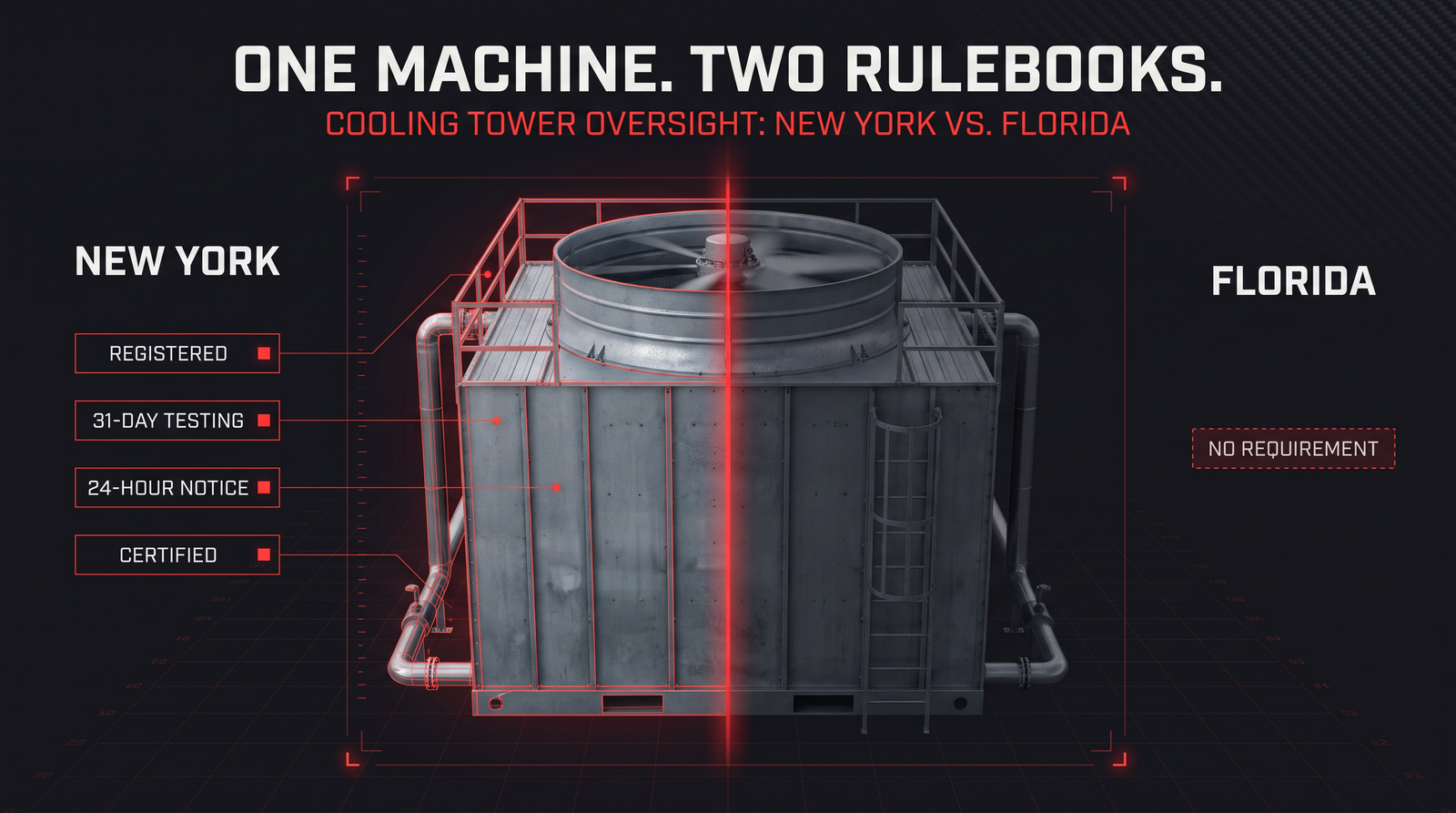
On August 5, 2026, New York signed a law tightening its New York City cooling tower rules: certification twice a year, maintenance deficiencies corrected within 48 hours, dangerous microbe levels within 24 hours, ten-year recordkeeping, and fines up to $12,500 when a violation causes a death or serious injury. It followed an Upper East Side outbreak that stands at 94 cases and 11 deaths, the city's deadliest since 2015. Three weeks later, Toronto traced its own outbreak to a single cooling tower. Florida has no cooling tower law at all. The bill that would have created one died in committee in 2020, and two more died in March 2026. There is no registry, no required test, no inspection schedule, and no inspector coming. If your association's building has a cooling tower, the only people deciding whether it is managed are your board, your manager, and your contractor. This article covers what changed, what Florida actually requires, and the seven questions a board should be able to answer.
Three things happened in three weeks
Cooling towers do not usually make the news. This summer they made it three times.
-
August 5, 2026 · New York
Governor Kathy Hochul signed legislation tightening New York City's cooling tower rules. Owners must now certify twice a year, in January and July, instead of once. Maintenance problems must be corrected within 48 hours, and microbe levels that present a serious health threat within 24 hours. Records must be kept for ten years instead of three. Fines rose to $2,500 for a first violation, $7,000 for a repeat, and up to $12,500 when a violation results in a fatality or serious injury. It landed on top of a separate city rule, effective May 2026, that shortened Legionella sampling from every 90 days to no more than 31 days apart.
-
August 25, 2026 · Toronto
Toronto Public Health confirmed that a cooling tower at the transit authority's Hillcrest Complex was the source of a Legionnaires' outbreak. Samples from the tower matched a sample from a patient. Six cases were confirmed within about a one-kilometre radius, and five more cases at a nearby long-term care home were flagged as a possible link. The transit agency shut down the cooling systems in two buildings and brought in a contractor to deep clean them.
-
September 1, 2026 · New York
The Upper East Side cluster stands at 94 cases and 11 deaths, two of them confirmed weeks after the city declared the exposure period over. It is New York City's deadliest Legionnaires' outbreak since 2015 and the second Manhattan outbreak in two summers, after a Harlem cluster in 2025. Dozens of buildings were ordered to drain, clean and disinfect their towers. And the detail that should stop every board member reading this: the source tower has still not been identified, with genetic matching results now expected in the fall. The same day, the city announced new measures including cross-matching its health and buildings department tower registrations and publishing a citywide cooling tower map in spring 2027.
Read that last line again. New York City has the most demanding cooling tower rules in the country. Every tower is registered. Every tower is sampled. The city had a list of buildings to test on day one. And it still lost 11 people and still could not say which tower did it.
One year earlier, Harlem went the other way. That 2025 cluster closed at 114 cases and 7 deaths, and the source was found: molecular analysis matched patient samples to cooling towers at a hospital and at a construction site. Same city, same rules, two different outcomes.
That is the honest starting point for this article. Registration and testing did not prevent either outbreak. What they bought was a list of towers to test within days, and, in one of the two, an answer. Florida would be starting from a blank page.
First, does your building even have one?
Not every condominium does, and this is worth confirming before anything else.
A cooling tower is the part of a central cooling plant that throws the building's heat away. Warm water comes back from the chiller, gets sprayed over fill material while a large fan pulls air through it, and a small part of that water evaporates. Evaporating is what carries the heat off. The rest drops into a basin and goes back around.
Two consequences follow from that description. First, the water is warm, open to the air, and sitting still whenever the plant is off. That is a good place for bacteria. Second, the fan pushes a fine mist out the top. The U.S. Centers for Disease Control and Prevention lists cooling towers among the building water systems where Legionella grows and spreads, and explains that people get Legionnaires' disease by breathing in mist containing the bacteria. It is not passed person to person. Somebody breathes it.
If your association runs a central chiller, you almost certainly have a tower or an evaporative condenser, usually on the roof or in a mechanical yard. If every unit has its own split system, heat pump or PTAC, you usually do not. Mid-rise and high-rise buildings are the ones most likely to have one, which is a large share of the South Florida condominium market.
Get the answer in writing from someone who has walked the roof. A board cannot manage equipment it does not know it owns.
What New York requires, and what Florida requires
New York State has regulated cooling towers since 2016, under Subpart 4-1 of the state sanitary code. New York City layers its own rules on top. Florida regulates none of it. The contrast is easier to see side by side.
| Requirement | New York | Florida |
|---|---|---|
| Registration | Every tower registered with the state; records updated every 90 days while operating | None |
| Written maintenance program | Required before the tower first operates, developed per ASHRAE Standard 188 | None |
| Inspections | Before seasonal start-up and every 90 days in use, statewide | None |
| Legionella sampling | Required, through a state-certified lab; since May 2026 New York City requires sampling no more than 31 days apart, reported within five days | None |
| Action on a bad result | Notify the local health department within 24 hours above 1,000 CFU/mL; New York City requires correction within 24 to 48 hours | No threshold, no deadline, no notice |
| Annual certification | Statewide certification by November 1; New York City now certifies in January and July | None |
| Recordkeeping | Ten years in New York City as of August 2026 | None required |
| How the state finds out | From the registry and the test results, before anyone is sick | From a doctor, after someone is sick |
That last row is the one that matters most, and it deserves its own explanation.
Florida's cooling tower law that never happened
Florida came close once.
On December 9, 2019, Senator Joe Gruters filed Senate Bill 1190 for the 2020 session. It would have required annual registration of every cooling tower in a state database, weekly aerobic bacteria sampling, monthly Legionella testing, maintenance and monitoring programs written by qualified professionals, compliance inspections every 90 days by independent inspectors, and mandatory reporting and public notice when bacteria exceeded set levels. It was modeled on what New York adopted after the 2015 Bronx outbreak.
It never got a floor vote. On March 14, 2020, the bill was indefinitely postponed, withdrawn from consideration, and died in the Health Policy Committee.
Nothing has replaced it since. In this year's session, Senate Bill 1654 and House Bill 1377 would have required cooling towers, domestic water tanks and supplemental disinfection systems to be registered with the Department of Health. Both died on March 13, 2026.
So what does Florida require today? One thing. Legionellosis is a reportable disease, and a doctor or lab must report a case to the health department by the next business day.
That is a detection system for sick people. It is not a prevention system for buildings. By the time it produces information about your tower, the information arrived through a resident's hospital admission.
The practical version: in New York, a building's cooling tower is a regulated asset with a file, a schedule and a deadline. In Florida, it is a piece of equipment on a roof. Whether it has a file, a schedule and a deadline is a decision your board makes, or a decision your board makes by not making it.
Florida is not a low-risk place for this
It would be easy to read all of this as a New York story. The Florida numbers say otherwise.
Orange County confirmed 100 cases of legionellosis in 2025, more than triple any other county in Central Florida. For comparison, Lake County recorded 30, Osceola 29, Brevard 25, Volusia 20 and Seminole 17. Reporting in early December 2025, when the county count stood at 82, described it as the worst year in three decades.
Nationally, the CDC reports that Legionnaires' cases have been climbing since the early 2000s. About 1 in 10 people who get the disease die from it. For people who catch it during a stay in a healthcare facility, it is closer to 1 in 4.
Then there is the part that makes this a condominium problem rather than a general building problem. The CDC lists who is most at risk of severe illness:
- Adults 50 years and older
- Current and former smokers
- People with chronic lung disease
- People with weakened immune systems, including those being treated for cancer or taking medication after a transplant
Most healthy people exposed to Legionella do not get sick. That list is not a description of most healthy people. In a South Florida residential building, it is a description of a meaningful share of the owners who elected you.
Add one more South Florida fact that no statute accounts for. A cooling tower in the northeast gets a cold season off. The state's rules are written around a seasonal start-up for exactly that reason. A tower in Fort Lauderdale, Miami or West Palm Beach does not shut down for winter. It runs warm, wet and outdoors, all year, in salt air. Whatever schedule a northern regulator considers adequate is a floor here, not a ceiling.
Why this lands on the board specifically
In most building systems there is a chain of people who will catch a problem: an inspector, a permit, an annual certification, an insurer's engineer. For a cooling tower in Florida, that chain does not exist. Nobody upstream of the association is assigned the job.
A tower that serves the whole building is a common element. It sits with the association the same way the roof and the elevators do. The board controls the budget that funds its care, approves the contract that maintains it, and receives, or does not receive, the reports that prove it happened.
That is not a comfortable position, but it is a manageable one. It comes down to three things a board can actually do: know what you own, fund a written program, and keep the paperwork.
The paperwork matters more than boards expect. After the 2025 Harlem outbreak, 16 lawsuits were filed on September 3, 2025 by people who got sick, naming building owners and a contractor working at one of the sites. Litigation of that kind turns on documents: what was the program, who performed it, when, and what did the results say. A board that can produce a dated file is in a very different position than a board that can produce a recollection.
One caveat, said plainly. This article is written by an HVAC contractor, not a law firm. How your governing documents assign the equipment, and what duty and liability follow from that, are questions for your association counsel. Ask them. The mechanical part is ours; the legal part is theirs.
What a real program looks like
Stripped of jargon, a cooling tower program has four pieces:
Water treatment. A treatment vendor controls biological growth, scale and corrosion in the water, tests it on a schedule, and leaves a report each visit. Most buildings that have a tower already have this. Fewer boards read the reports.
Mechanical maintenance. Treatment chemistry cannot fix a fouled basin, torn drift eliminators, clogged fill, a failing float, or a fan and drive running out of spec. Drift eliminators are worth naming specifically: their job is to knock water droplets out of the air leaving the tower. That is the mist. Treatment and mechanics are two halves of one job, and a lot of buildings buy one and assume they bought both.
Testing and records. A defined test, on a defined interval, from a lab, filed where the next board can find it. Florida sets no interval, so your program has to state one.
A written response plan. Who is called, who can shut it down, who cleans it, who notifies the county, who tells residents. Decided in advance, on a normal Tuesday, not during the phone call.
We are not going to print a dollar figure here, because a number that does not know your tower, your plant, or your building is a number that will be wrong. What we will say is that this belongs in the operating budget as a recurring line, and the tower itself belongs in the reserve study as an asset with a service life. If it appears in neither, that is the finding.
Where ABC Mechanical fits
We maintain and service cooling towers across South Florida, on condominium towers, schools and large commercial plants. We are not a water treatment company, and we will tell you that in the first meeting. What we do is the mechanical half, and the coordination that makes both halves add up to one program with one paper trail.
If your board cannot answer the seven questions below, the useful first step is small: a cooling tower condition assessment. We walk the tower, document what is there and what shape it is in, review the treatment records you already have, and give you a written picture you can put in front of the board and the reserve study.
If you want the engineering in more depth, our companion article, Cooling Towers Are Public Health Infrastructure, covers the six conditions that turn a tower into a hazard and includes our full white paper as a PDF. For the wider capital picture, see the high-rise capital planning primer.
Sources
Figures in this article are taken from the sources below and were current as of September 2, 2026. The Upper East Side investigation was still open at the time of writing: New York City had not identified the source cooling tower and expected genetic matching results in the fall of 2026. Case and tower counts in an active outbreak move; where a figure is a snapshot, the date is given. Nothing here is legal advice; boards should confirm how their own governing documents and Florida law apply to their building with association counsel.
- “Governor Hochul Signs Legislation Strengthening Inspections on Cooling Towers in New York City.” Office of the Governor of New York State. August 5, 2026 signing; S08472-A / A09058A; biannual certification, 48- and 24-hour correction windows, penalty amounts
- “New Legionnaires' Disease Regulations.” Habitat Magazine. Board-facing summary of the New York City changes: certification cycle, ten-year record retention, revised fine amounts
- “TTC cooling tower source of legionnaires' disease outbreak in Toronto.” CP24. August 25, 2026 source confirmation at the Hillcrest Complex, case counts, remediation
- “Death toll rises to 11 in Upper East Side Legionnaires' outbreak.” CBS News New York. Upper East Side totals of 94 cases and 11 deaths; source tower not identified as of late August 2026
- “NYC Health Provides Preliminary List of UES Cooling Towers Where Testing Confirms Live Legionella.” New York City Department of Health and Mental Hygiene. July 21, 2026 snapshot: 34 towers at 33 buildings positive for live Legionella; remediation orders. The tally rose as testing continued
- “NYC Health Provides Update on Community Cluster of Legionnaires' Disease in Central Harlem.” New York City Department of Health and Mental Hygiene. The 2025 Harlem cluster while it was still open (92 cases, 3 deaths, 12 towers on 10 buildings)
- “16 People File Legionnaires' Disease Lawsuits Over the Harlem Cooling Towers.” PR Newswire. September 3, 2025: 16 suits filed by people sickened in the Harlem cluster
- “Health Department Closes Investigation into the Central Harlem Legionnaires' Cluster.” New York City Department of Health and Mental Hygiene. Final Harlem totals of 114 cases and 7 deaths, and the identification of the source cooling towers
- “Mayor Announces New Measures to Strengthen Cooling Tower Oversight.” Office of the Mayor of the City of New York. September 1, 2026: registration cross-matching, the citywide cooling tower map planned for spring 2027, and the current case and death totals
- “Senate Bill 1654 (2026).” The Florida Senate. The 2026 cooling tower registration bill, and its companion House Bill 1377, both died on March 13, 2026
- “Senate Bill 1190 (2020).” The Florida Senate. Filed December 9, 2019; indefinitely postponed and withdrawn, died in Health Policy on March 14, 2020
- “Florida Senator Proposes Statewide Cooling Tower Regulation.” Goldberg Segalla, Environmental Law Monitor. What SB 1190 would have required: registry, weekly and monthly sampling, 90-day independent inspections
- “Protection Against Legionella: Cooling Tower Requirements.” New York State Department of Health. Subpart 4-1: registration, ASHRAE 188 maintenance plan, 90-day inspections, November 1 certification, 1,000 CFU/mL notification
- “Cooling Tower Registration and Maintenance.” New York City Department of Health and Mental Hygiene. New York City sampling interval, reporting window, and recordkeeping
- “Reportable Diseases and Conditions in Florida: Practitioner List.” Florida Department of Health. Legionellosis is reportable in Florida by the next business day
- “Orange County leads Central Florida in Legionnaires' Disease cases, 100 confirmed.” WFTV. December 23, 2025: Orange County 2025 case count and the Central Florida county comparison
- “Legionnaires' disease cases on the rise in Orange County.” WUSF, Health News Florida. December 5, 2025: the year described as the county's worst in three decades
- “About Legionnaires' Disease” and “Causes and Transmission.” U.S. Centers for Disease Control and Prevention. Transmission by inhaled mist, cooling towers as a source, roughly 1 in 10 fatality rate, and the higher-risk groups
- “ANSI/ASHRAE Standard 188-2021, Legionellosis: Risk Management for Building Water Systems.” ASHRAE. The voluntary standard covering multi-unit residential buildings, adopted by reference in New York