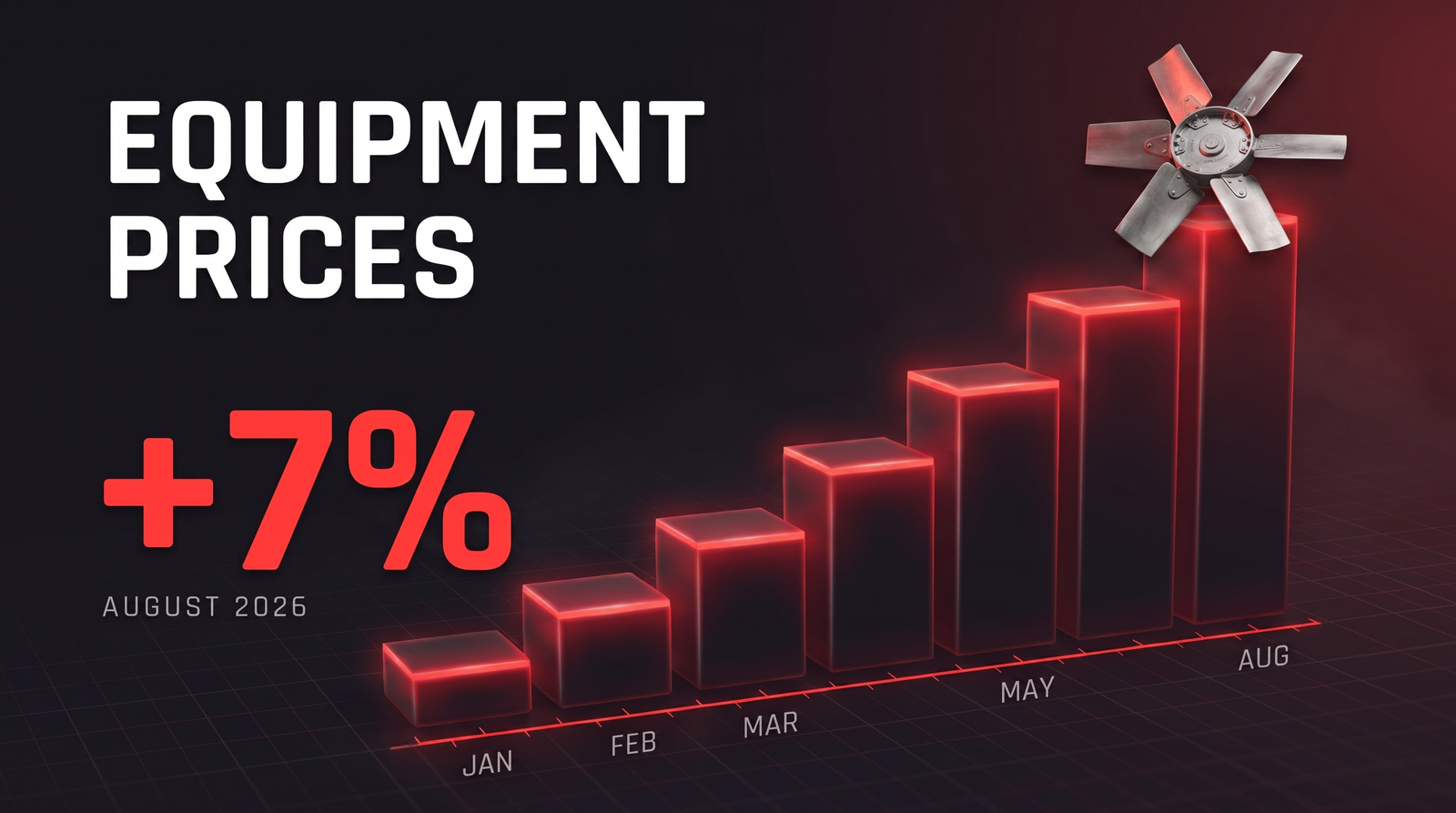
On August 3, Daikin, Goodman and Amana each raised list prices up to 7%, and Bard raised its lines about 6%. Parts went up more — Lau announced 16.2–16.8% on parts effective August 31, and Legend Valve announced 3–25% depending on the item. This is the fifth round of increases this year, not a one-time jump. The causes are metal tariffs, the new refrigerant rules, freight, and a shrinking labor pool — none of which get resolved this quarter. For a South Florida building, the practical takeaway is simple: the equipment you replace on a plan will cost less than the same equipment replaced in a panic. Get quotes early, find out how long they hold, and stop letting a breakdown pick your purchase date.
What actually changed on August 3
Every month, The ACHR News publishes a running list of manufacturer price increases. August 2026 was a long one — more than a dozen companies on it, covering equipment, parts, sheet metal, valves, motors, and indoor air quality products.
Here are the ones that matter most to a commercial building owner:
| Manufacturer | Increase | Effective | What it covers |
|---|---|---|---|
| Daikin | Up to 7% | Aug 3 | Equipment |
| Goodman | Up to 7% | Aug 3 | Equipment |
| Amana | Up to 7% | Aug 3 | Equipment |
| Bard Manufacturing | ~6% avg | Aug 3 | Equipment |
| Lau | 16.2–16.8% | Aug 31 | Parts (blowers, motors) |
| Legend Valve | 3–25% | Aug 1 | Valves, by product line |
| tekmar | 5–7% | Aug 1 | Controls |
| Art's Sheet Metal | 5% | Aug 1 | Sheet metal |
| AprilAire | 0–4% | Aug 1 | IAQ products |
| RectorSeal | 3% | Aug 6 | Chemicals, accessories |
Several more — Broan-NuTone, DiversiTech, Harris Products, Navien, Aspen Coils, and Miller/Nortek — announced increases without publishing a percentage.
One thing to keep straight: these are list price changes. What your building actually pays depends on the specific equipment, the distributor, your contractor's buying position, and when the order is released. A 7% list increase does not automatically become 7% on your invoice. But it does move the floor, and the floor has been moving all year.
This is the fifth round in eight months
The August wave reads very differently once you line it up with the rest of 2026. This is not a single announcement — it's a pattern.
| When | Who | Increase |
|---|---|---|
| January 1 | Trane | Up to 5% |
| February 16 | Lennox (residential) | Up to 10% |
| March 2 | Daikin — ductless, VRV, light commercial | Up to 7% |
| March 2 | Goodman/Daikin parts | 11% |
| March 15 | Allied Air | Up to 7% |
| May 18 | Lennox Commercial | Up to 8% |
| May 25 | WaterFurnace | 3.9% avg + 1.1% surcharge |
| August 3 | Daikin, Goodman, Amana, Bard | 6–7% |
Increases stack. They don't reset. A line that went up 7% in March and 7% again in August is not 7% higher than it was in February — it's about 14% higher. If your capital budget was built on a 2025 quote, it is now materially short.
Why the prices keep climbing
Four separate pressures are pushing in the same direction, and none of them is a short-term blip.
Tariffs on steel, aluminum and copper
On April 6, 2026, Section 232 tariffs were expanded and — importantly — changed how they are calculated. Duties now apply to the full customs value of an imported product, not just the metal content inside it. HVAC equipment is metal: steel cabinets, aluminum and copper coils, copper tubing, motors, compressors, controls. That change alone raised landed cost across a wide range of parts.
The A2L redesign is not free
Under the federal AIM Act, manufacturers moved off R-410A to lower-GWP A2L refrigerants like R-454B and R-32. That meant redesigned equipment, new leak-detection and safety requirements, new components, and retraining. Those engineering and compliance costs are now baked into the price of every new machine.
It costs more to move a rooftop unit
Fuel and freight surcharges have climbed through 2026. HVAC equipment is heavy, bulky, and often needs flatbed or specialized transport. Every added dollar per mile shows up somewhere in the delivered price — and South Florida sits at the end of a long haul from most factories.
Not enough trained technicians
HVAC technician employment is projected to grow about 8% through 2034, with roughly 40,100 openings a year. Manufacturers, distributors and contractors are all competing for the same skilled people. That raises the cost of building equipment and the cost of installing it.
It's worth noting that tariff policy has not moved in only one direction — some equipment categories saw rates eased in mid-2026. But manufacturers have generally not reversed announced increases when that happened. Once a price list moves up, it tends to stay up.
What this means for a South Florida building
Rising equipment prices hit coastal Florida harder than most markets, for three reasons that compound each other.
Our equipment doesn't last as long. Salt air, year-round runtime, and constant humidity shorten service life — sometimes dramatically. Our piece on why AC units die faster within five miles of the beach covers how much. A shorter replacement cycle means you buy into these price lists more often than a building in Atlanta does.
Our failures happen at the worst possible moment. August is peak load. A compressor that fails now is an emergency, and an emergency replacement means taking whatever unit is available at whatever it costs, with no time to compare quotes or wait for a better lead time. The price increase is bad; the panic premium on top of it is worse.
Our cooling bill is going up too. The same summer that brought these increases has brought record cooling demand across Florida, on top of higher utility base rates. If an aging, inefficient unit is already costing you on the demand charge side of the bill, keeping it one more year is no longer the cheap option it looks like on paper.
Five things to do before the next increase
1. Pull your capital plan forward, not backward
If you have a unit scheduled for replacement in the next 12 to 18 months, price it now. You are not trying to time the market — you are trying to avoid buying at the end of another three or four announced increases, in an emergency, at peak season. Our capital-planning primer walks through how to sequence this across a portfolio.
2. Ask exactly how long a quote holds
This is the most valuable question in the room right now, and most people don't ask it. Quotes are not all the same. Some hold price until the next announced effective date. Some hold 30 days. Some hold only until the order is released to the factory — which means a long lead time can cross an increase and change your number after you thought you were locked. Get the hold period in writing, and ask whether a deposit locks the price.
3. Watch lead time as closely as price
A great price on a unit that arrives in 22 weeks is not a great price if your existing machine won't survive 22 weeks. Ask for the current factory lead time before you compare bids, and build the schedule backward from when you actually need the equipment running.
4. Protect what you already own
Every year of extra life you get out of a working unit is a year you don't buy into a higher price list. That makes preventative maintenance a better financial decision in 2026 than it was in 2024 — coil cleaning, belt and bearing service, refrigerant charge, controls calibration, and corrosion protection on coastal equipment. Our breakdown of preventative maintenance for South Florida properties lays out what that program actually includes.
5. Consider upgrading instead of replacing
When the mechanical core of a system is sound but it runs inefficiently, an upgrade can deliver most of the benefit of replacement for a fraction of the cost — variable-frequency drives, modern controls and building automation, better filtration, coil coatings. As new equipment gets more expensive, that middle path gets more attractive. We covered how to make that call in repair, upgrade, or replace.
How ABC Mechanical handles this for clients
We track manufacturer announcements as they're published, and we tell clients what's coming rather than quoting into an increase and explaining it afterward. When we specify equipment, we confirm the price-hold terms and the current factory lead time in writing before anyone commits.
Being manufacturer-agnostic matters more in a market like this one. ABC is certified across a deep bench of manufacturers — York and TempMaster rooftops and split systems, Hitachi VRF, Quantech and Thermal Care chillers, Krueger air handlers, Bosch Florida Heat Pump water-source units, Wilo pumps, Johnson Controls drives and controls, Camus boilers, Evapco-Alcoil coils, plus Fresh-Aire UV, Phenomenal Aire, and Bronz-Glow protection. When one line raises prices or stretches lead times, we can specify a different one that meets the same requirement instead of telling you to wait.
Prices are going to keep moving. The part you control is whether you're buying on your schedule or on the equipment's. See the full scope of our commercial HVAC services across South Florida — Fort Lauderdale, Miami, and the Palm Beaches.
Sources
Figures in this article are taken from the sources below and were current as of August 8, 2026. Manufacturer increases are announced list price changes; actual pricing varies by equipment, distributor and order timing.
- “HVAC Price Increase List: August 2026.” The ACHR News. August 2026 manufacturer increases and effective dates
- “2026 HVAC Price Increases.” Paschal Air, Plumbing & Electric. January–May 2026 increases by brand
- “Why Commercial HVAC and Equipment Costs Are Rising in 2026.” SSI Services. Commercial equipment increases, tariff and freight pressure
- “United States Modifies Steel, Aluminum and Copper Section 232 Tariffs.” White & Case LLP. April 6, 2026 tariff rates and full-customs-value change
- “Phasing Down Hydrofluorocarbons (AIM Act).” U.S. Environmental Protection Agency. Refrigerant phase-down driving the A2L equipment transition
- “Heating, Air Conditioning, and Refrigeration Mechanics and Installers.” U.S. Bureau of Labor Statistics, Occupational Outlook Handbook. Employment growth and projected annual openings
- “What’s Causing HVAC Prices to Rise in 2026.” Money. Consumer-side summary of the same cost drivers