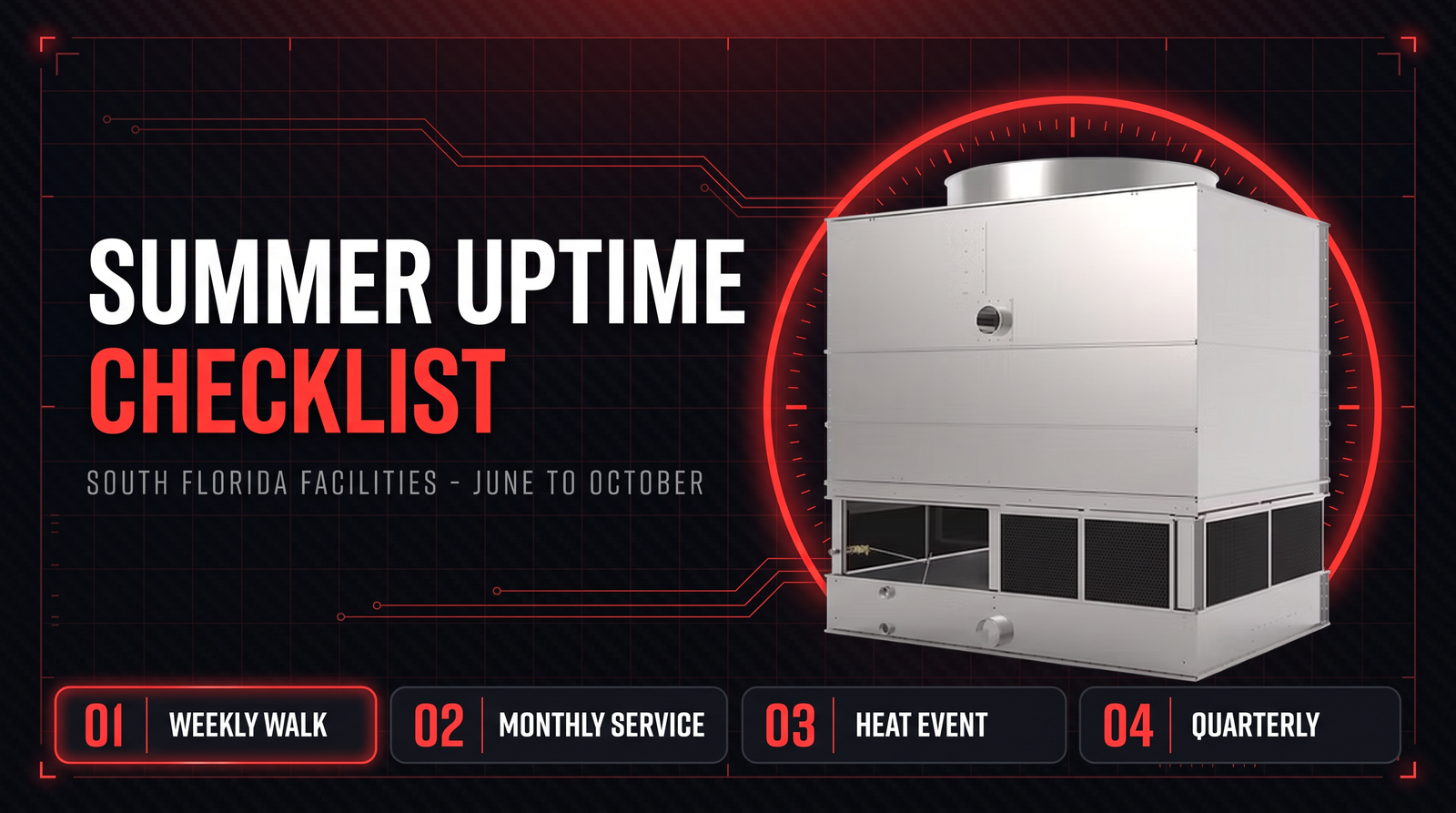
July and August are when South Florida buildings break — not because something suddenly went wrong, but because equipment that was already weak in May finally runs out of margin. The fix is boring and it works: a short list of checks on a fixed schedule, done by your own engineering staff, backed by a contractor for the items that need gauges and certification. This guide gives facility managers and HOA managers three things. First, the numbers your board actually needs — simple formulas you can fill in from your own FPL bill to show what neglect costs and what the checklist saves. Second, a printable summer uptime checklist you can hand to your engineering department today, with weekly, monthly, and heat-event tasks and a sign-off line. Third, the short list of warning signs that mean stop and call a contractor before a repair turns into a replacement.
Why buildings fail in July and August, not in May
A cooling system does not usually die from a single event. It dies from a slow loss of margin. In March, a rooftop unit with slightly dirty coils, a filter two months overdue, and a refrigerant charge that is 8% light still holds setpoint without complaint — because it only needs to deliver half its capacity. The building never notices.
By the first week of August, that same unit is being asked for 100% of its rated capacity for ten hours a day, with warm nights that never let it recover. Now every one of those small deficits shows up at once. The coil that costs 20% of capacity, the airflow restriction that costs another 10%, and the light charge that costs 10% more do not add up politely — they compound into a machine that physically cannot make the building comfortable, running flat out, drawing full amps, and heading toward a compressor failure.
That is the whole logic of summer uptime work. You are not fixing problems. You are removing the small deficits before the season demands full capacity. Every item on the checklist below exists to buy back a few percent of capacity and a few percent of efficiency. Together they are the difference between a building that rides out August and a building that goes down on a Friday afternoon at emergency rates.
The failure you pay for in August was created in May. Equipment does not fail at 100% load because the load is high. It fails because nothing was left in reserve when the load arrived.
The three numbers your board needs
Boards and owners approve maintenance budgets when they can see the arithmetic. Here are the three calculations that make the case, in a form you can fill in from documents you already have. None of them require an engineer — just last summer's utility bills and your service history.
Number 1: What the system wastes when it is neglected
Cooling is usually the largest single line on a commercial or common-area electric bill in South Florida — commonly around 40% to 60% of summer consumption in air-conditioned buildings. Neglect does not shut a system off; it makes it buy the same cooling at a worse price. Published efficiency penalties for the most common problems fall in these ranges:
| Neglected item | Typical efficiency penalty | What it does |
|---|---|---|
| Fouled condenser coils | 10–30% more compressor energy | Raises head pressure; the compressor works harder for the same cooling |
| Loaded filters / restricted airflow | 5–15% capacity and efficiency loss | Starves the coil, drops airflow, can freeze the coil outright |
| Refrigerant charge off by 10% | 5–20% efficiency loss | Undercharge cuts capacity; overcharge raises pressure and shortens compressor life |
| Dirty evaporator coil | 5–15% capacity loss | Reduces heat transfer and hurts dehumidification |
| Failed economizer or stuck damper | Up to 20–30% on affected units | Pulls in hot outside air or blocks free cooling entirely |
The board-ready formula:
Summer cooling spend (June–September electric bills × your cooling share, use 50% if unknown) × estimated efficiency penalty = annual dollars wasted on avoidable inefficiency.
A property spending $40,000 across the summer on electricity, with roughly half of that going to cooling, and equipment carrying a conservative 15% penalty, is burning about $3,000 every summer to buy cooling it should be getting for free — before a single breakdown. Run your own numbers. The figure is almost always larger than the maintenance contract.
Number 2: What one unplanned failure costs
Planned work and unplanned work are not the same purchase. A scheduled repair happens on a Tuesday morning at standard rates with the part ordered in advance. The same repair after a failure happens at night or on a weekend, at premium labor rates, often with expedited parts, sometimes with temporary cooling rented by the day — plus the soft costs nobody puts on an invoice.
The board-ready formula:
(Emergency labor premium) + (expedited parts) + (temporary cooling, if needed) + (collateral damage, e.g. water from a frozen coil) + (hours of disrupted operation × your cost per hour) = the true cost of one failure. Multiply by the number of at-risk units.
For an association, the soft costs are real even when they are hard to price: resident complaints, board meetings, emergency assessments, and in a Florida summer, genuine health risk for older residents. For a commercial tenant building, they are lease obligations. This is the number that turns "we should do maintenance" into "we cannot afford not to."
Number 3: The demand charge you set in fifteen minutes
Commercial and common-area meters usually carry a demand charge — a monthly fee based on your single highest 15-minute power draw, billed per kilowatt on top of everything you actually consumed. Pull a recent bill and find the line. It will show your billed demand in kW and a rate per kW. That one worst quarter-hour sets the charge for the whole month.
The board-ready formula:
Billed peak demand (kW) × demand rate ($/kW) × 12 months = annual demand cost. Now recalculate with a 10% lower peak — that difference is what load staggering and morning pre-cooling are worth, with no capital spending at all.
Peaks are made by simultaneity: every rooftop unit, pump, and chiller starting into the same fifteen minutes after a setback, usually mid-morning as the heat is climbing. Staggered starts, gentler recovery ramps, and pre-cooling before the peak window move that number without touching comfort. We broke the mechanics down in Billed for Your Worst 15 Minutes.
How to use the checklist
The checklist below is written to be printed and handed to your engineering staff. It is organized by frequency, so it drops straight into an existing routine: a weekly walk, a monthly block, a short list for the day before a heat event, and a quarterly block that mostly belongs to your contractor.
Three rules make it work:
- Assign it to a person, not a department. A checklist owned by "engineering" gets done sometimes. A checklist with a name and a sign-off line gets done weekly.
- Record the readings, not just the checkmarks. Supply and return temperatures, amp draws, and pressures only mean something as a trend. A number that has been drifting for six weeks is a warning; the same number in isolation is noise.
- Know the stop line. Some items are in-house work. Some — anything touching refrigerant, electrical repairs beyond a reset, or anything under warranty — require a licensed technician. Those are marked.