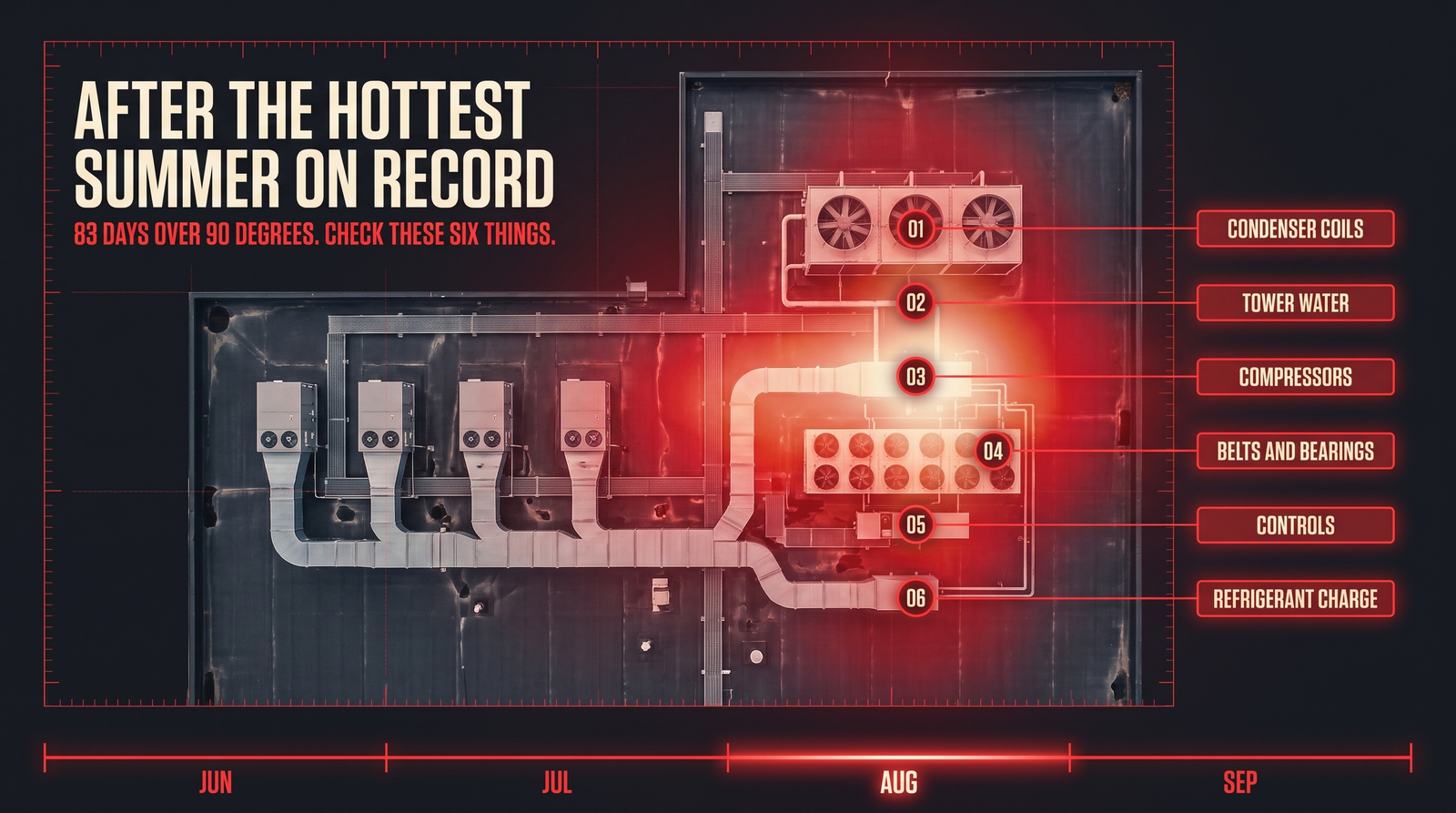
Meteorological summer 2026 was the hottest on record at Fort Lauderdale and West Palm Beach, and tied the record at Miami. Miami spent 83 days at or above 90 degrees against a normal of 64, hit 100 degrees on August 18 to tie an all-time record that had stood alone since 1942, and finished with its 8th driest summer on record. Commercial cooling equipment does not usually break during a season like that. It breaks in the eight weeks afterward, when the load starts swinging and everything that wore out in silence gets asked to start and stop again. This article covers what the season actually did to the hardware, the six things worth checking on the roof right now, and why the answer belongs in the 2027 budget that most South Florida boards are about to approve.
On a Tuesday in August, a service tech stood on a roof in Doral and watched the infrared gun read 163 degrees off the membrane next to a condenser. The unit was running fine. That is the part worth sitting with. It was running fine.
We should say the obvious thing early. We are an HVAC contractor, and an article that ends with "you should get your equipment inspected" is not a neutral document. So here is the honest version of the argument, including the part that does not help us: if your equipment is newer, well maintained, and was actually serviced this spring, a hot summer is something it is built to absorb. You do not need us in October. If your equipment is past twelve years, or you skipped a quarterly, or nobody has pulled an amp reading since March, this particular summer moved your replacement date closer and did not tell you by how much. Those are two different buildings, and the only way to know which one you have is to look.
What the season actually was
The numbers come from the National Weather Service office in Miami, which publishes a seasonal climate summary for South Florida. Here is the part that matters to a mechanical system.
Nationally it was the same story. NOAA's climate monitoring office recorded the warmest summer on record for the contiguous United States at 74.4 degrees, three degrees above the twentieth century average, beating the previous marks from 1936 and 2021 by four tenths of a degree. August alone was the warmest August in a record that goes back to 1895.
But the number that gets overlooked is the rain, or the lack of it. Miami International recorded 12.71 inches of rain for the summer. Normal is about 27. That is a deficit of 14.74 inches and the 8th driest summer since records began in 1895. Across South Florida the deficit ran roughly 5 to 10 inches below normal, with parts of the southeast coast running 12 to 15 inches short, and most official sites landing in their top ten driest summers.
Hot and dry together is worse for equipment than hot alone, and the reasons are not obvious until someone points at them.
The mistake is thinking the damage already showed up
A building owner reads a summary like the one above and checks it against experience. No outages in July. No emergency calls in August. Conclusion: we came through it.
That conclusion is understandable and it is usually wrong, because running and being healthy are not the same condition.
Through the peak of a South Florida summer a cooling system is under continuous high load. The parts that are wearing out sit in one thermal and mechanical state for weeks. Bearings stay hot and loaded. Contactors stay closed instead of cycling. Compressors run long, steady cycles at elevated head pressure rather than starting and stopping all day. Wear is accumulating the entire time. Almost none of it announces itself, because the system is still meeting the load, just by force.
Then the load starts swinging. September and October in South Florida still bring real heat, but they bring it unevenly, with cooler mornings and afternoon swings that summer did not have. Units short cycle. Compressors and contactors take start inrush again and again after ten weeks of thermal stress. A contactor with pitted points finally welds. A capacitor that was already weak drops out of spec. A glazed belt slips. A bearing that ran hot all season starts to make a noise somebody notices.
We want to be careful here, because it would be easy to overstate this. We are not aware of a published study that puts a percentage on post-season commercial HVAC failures in this market, and we are not going to invent one. What we can say is that this is the pattern our own technicians see, year after year, and it is consistent enough that the fall inspection is the one we push hardest.
What the drought did that the heat did not
Three effects, and the first one surprises people.
Nothing rinsed the coils. In a normal South Florida summer, frequent heavy rain washes salt and grime off outdoor coils several times a week for free. That did not happen this year. On a coastal or near-coastal building, salt aerosol kept landing on condenser coils and kept staying there, on aluminum fins, in heat, for months. Fouled coils raise head pressure, which raises energy cost and compressor stress at the same time. Corrosion does the slower damage underneath. If you have read our piece on salt air corrosion, this is that problem with the one natural mitigating factor switched off.
Cooling towers drank more and got dirtier. A tower rejects heat by evaporating water. A hotter, drier season means more evaporation, more makeup water, and dissolved solids concentrating faster in the basin. Scale forms more readily. Biological conditions get more favorable. None of that is exotic, it is just tower chemistry running at the hot end of its range for longer than usual, which is exactly when treatment programs that were adequate in a normal year stop being adequate. We have written separately about what Florida does and does not require of cooling tower operators, and the short version is that almost all of it is on the owner.
Drought conditions persisted. Extreme drought held over the southern Everglades through the end of summer. For a commercial property that is mostly a water-cost and water-restriction question, and it is worth knowing before a tower cleaning gets scheduled.
Six things to check now
This is a targeted post-season list, not a full preventive maintenance scope. Items one through three can be done by an in-house engineering department in an afternoon. Items four through six need a licensed technician with gauges.
-
Condenser coils, looked at closely
Not a glance from the walkway. Get in front of the coil face, look between the fins, and look at the fin edges for whitish salt deposits and for aluminum that has started to powder. Check the discharge side too, since debris pulls through.
Why now Four months of accumulation with no rain to carry it off. A coil cleaning is cheap. The compressor it protects is not. -
Tower basin, fill, and water chemistry
Pull the basin cover. Look for scale on the fill, sediment depth in the basin, and any biological film. Then ask your water treatment vendor for the last three months of test results rather than a verbal assurance, and read what happened to conductivity and cycles of concentration in July and August.
Why now A season of elevated evaporation changes the chemistry faster than the service interval assumes. -
Belts, sheaves, and bearings
Check tension and alignment on every belt. Look for glazing, cracking, and belt dust in the cabinet. Listen to each fan and blower with the panel open, and note anything that sounds different than it did in May.
Why now Rubber ages fast in sustained heat, and a belt that held through August under steady load is a different belt than it was in spring. -
Amp draw on every compressor and fan motor
Read it and write it down next to the nameplate rated load amps. A motor drifting toward its rating is telling you something specific. If you have readings from spring, compare them. If you do not, start the record now so next year's check means something.
Why now This is the single most useful number for separating equipment that absorbed the season from equipment that is limping. -
Contactors, capacitors, and control wiring
Open the electrical compartment. Look at contactor points for pitting and heat discoloration, check capacitor microfarads against the rating rather than assuming, and look for insulation that has gone brittle or discolored near hot components.
Why now These are the parts that survive a steady season and then fail on the restart cycles that fall brings. -
Refrigerant charge and superheat, verified with gauges
A system can run all summer with a slow leak and still hold a space, because it is working harder to do it. That shows up as high head pressure, longer run times, and a utility bill nobody connected to the equipment. Verify the charge properly and find the leak if there is one.
Why now Sustained high head pressure is exactly the condition that opens marginal joints, and refrigerant is more expensive and harder to source than it was two years ago.
The season is not actually over
Worth saying plainly, because the fall inspection often gets pushed to "after it cools off." In South Florida that is a long wait. The Weather Service puts the end of the rainy season around October 15, notes that summer-like heat and humidity often linger well into October, and says temperatures in the 50s are not typical here until late October or November. The Climate Prediction Center's seasonal outlook favored above-normal temperatures for September through November.
So the equipment is still carrying load. That is the argument for checking it now rather than in January, and it is also the reason a failure this month still produces the same complaint calls a failure in July would have.
Why this belongs in a budget conversation, not just a maintenance one
Most Florida condominium and HOA boards are building the 2027 budget right now. Under section 718.112 of the Florida Statutes, a condominium association has to deliver the proposed annual budget to unit owners at least 14 days before the meeting where it is adopted, and adopt it at least 14 days before the fiscal year starts. For a building on a calendar fiscal year, that work is happening in October and November. Many declarations require more notice than the statute does, so the real deadline is often earlier than people assume.
Which means there is a narrow window where a mechanical condition report can still change a number instead of becoming a surprise.
Two things make that window matter more this year than usual. The first is that heating and cooling equipment is not among the seven components Florida's Structural Integrity Reserve Study statute names, so for many associations the most expensive machine on the property is not automatically covered by the one capital document the state requires. The second is equipment cost. Manufacturer price increases have been announced steadily through 2026, including equipment brands in the August round. A replacement figure that was carried forward from a 2024 or 2025 estimate is not a current number.
We are not going to dress that up into an emergency. Most buildings do not need to replace anything this year. But a board approving a 2027 budget with a mechanical reserve line that was last touched two years ago, after the hottest summer either of its records has seen, is making a guess and calling it a plan.
One date that is genuinely close
If your building uses VRF, which stands for variable refrigerant flow and is common in South Florida mid-rise and hospitality work, there is a deadline worth knowing about.
EPA published a final rule on May 26, 2026, effective July 27, that removed the January 1, 2026 deadline for installing residential and light commercial R-410A systems that were manufactured or imported before January 1, 2025. Those can now be installed until existing supplies run out. A lot of coverage stopped there and left the impression that the R-410A deadline problem went away.
It did not for VRF. VRF was excluded from that relief and still carries a January 1, 2027 installation deadline, with a later date for certain projects permitted before October 2023. That is inside a normal procurement cycle for a building of any size. The January 1, 2025 cutoff on manufacturing and importing R-410A equipment also did not change.
If a VRF replacement is anywhere in your next two years, the conversation about timing is worth having in October, not December.
What we would tell a board in one paragraph
The season that just ended was the hottest either Fort Lauderdale or West Palm Beach has on record, and one of the driest. Your equipment spent months meeting that load, and the cost of doing it came out of remaining service life rather than out of the operating account. You cannot see that balance from the ground. A post-season inspection tells you how much you spent, converts it into a number, and gets that number in front of the board while the budget is still a draft. If the answer is that everything is fine, that is a genuinely useful thing to be able to tell owners in a meeting.
Sources
Climate figures are from the National Weather Service and NOAA, current as of September 19, 2026, and describe meteorological summer 2026, June 1 through August 31. Seasonal outlooks are forecasts and not guarantees. Statutory references are to the 2026 Florida Statutes; nothing here is legal advice, and how any provision applies to your building depends on your declaration and your building's history, which are questions for association counsel. The failure-timing pattern described in this article reflects our own field experience in South Florida and is not presented as a published statistic.
- “South Florida Summer 2026 Climate Summary.” NOAA National Weather Service, Miami. Seasonal averages and departures for Miami, Fort Lauderdale, West Palm Beach and Naples; days at or above 90 degrees against normals; the all-time record-tying 100 degrees at Miami on August 18; the 12.71 inch summer rainfall total and its 14.74 inch deficit; regional rainfall deficits and driest-summer rankings; and the fall outlook including the mid-October end of the rainy season
- “Assessing the U.S. Climate in August 2026.” NOAA National Centers for Environmental Information. Summer 2026 as the warmest on record for the contiguous United States at 74.4 degrees, three degrees above the twentieth century average, and August 2026 as the warmest August in the 1895 to present record
- “Sizzling summer ends with record heat in Fort Lauderdale and West Palm.” WLRN, September 1, 2026. Secondary summary of the Weather Service figures above, included for readers who want the local reporting rather than the source document
- “718.112 Bylaws.” The 2026 Florida Statutes. The 14-day budget delivery requirement at (2)(e)1 and the 14-day pre-fiscal-year adoption requirement at (2)(f)1; the seven named Structural Integrity Reserve Study components and the two-part catch-all at (2)(g)1
- “EPA Finalizes Refrigerant Rule Update to Allow Older HVAC Unit Installation.” National Association of Home Builders, May 2026. The final rule published May 26, 2026 and effective July 27, 2026, removing the January 1, 2026 installation deadline for pre-2025 R-410A residential and light commercial equipment
- “EPA lifts R-410A installation deadline, but refrigerant prices could rise.” Air Conditioning Contractors of America. The VRF exclusion from that relief and the remaining January 1, 2027 VRF installation deadline, with a later date for certain projects permitted before October 2023
- “HVAC Price Increase List: August 2026.” The ACHR News. Manufacturer price increases announced for August 2026, including equipment brands, used only to support the statement that carried-forward replacement estimates are out of date