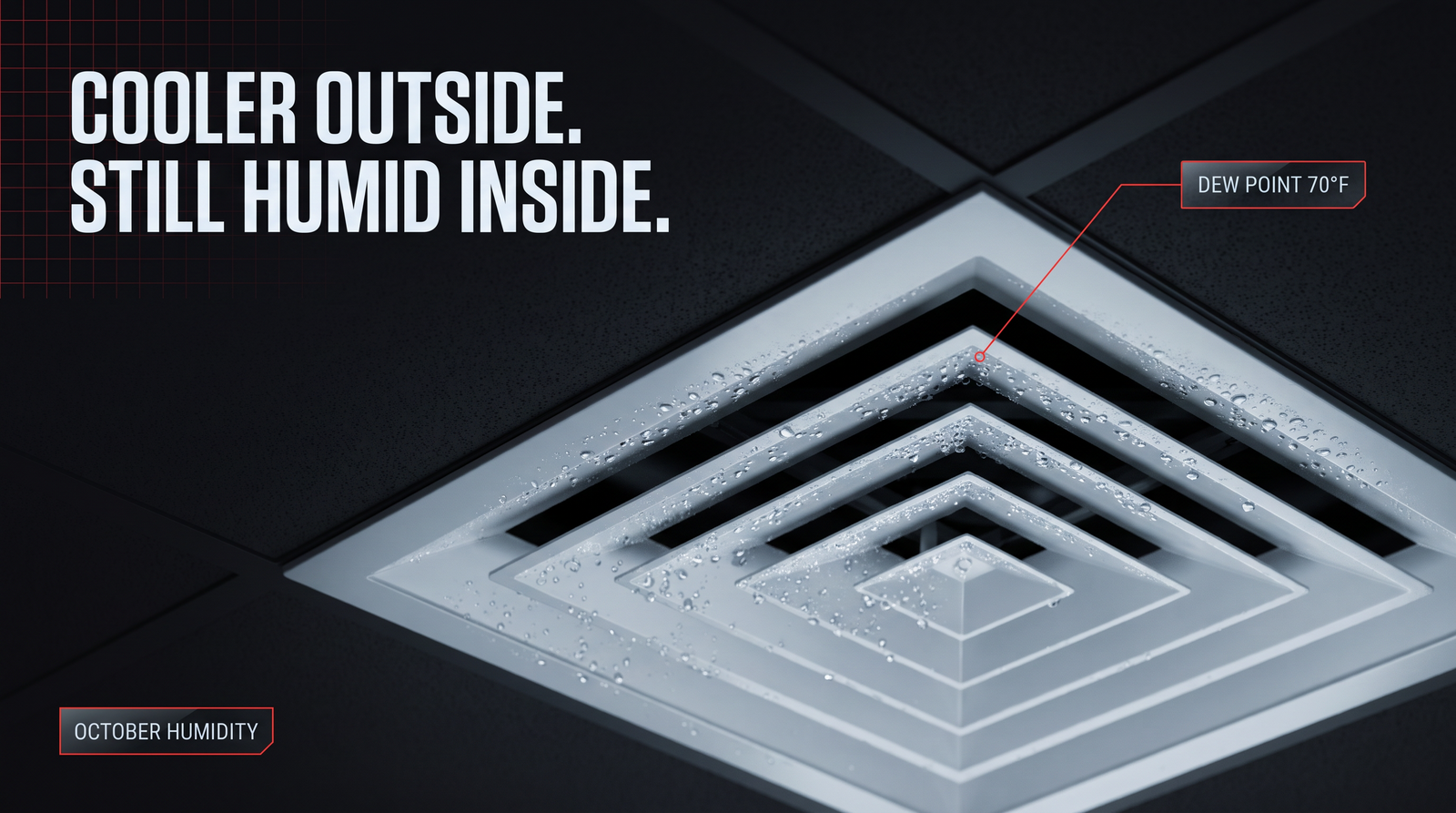
The National Weather Service puts the end of South Florida’s rainy season at October 15, but the average October dew point at Miami International is still about 70°F. Outdoor air stays humid while cooling loads fall, so equipment cycles off sooner and removes less moisture. EPA recommends holding the indoor dew point below 55°F in humid weather and relative humidity below 60 percent. The usual fixes are operational: lock out economizers on outdoor dew point, close outdoor air in unoccupied hours, verify dampers move, balance exhaust with makeup air, and stop lowering thermostats. A larger air conditioner is usually not the fix.
The calendar says dry season. The National Weather Service in Miami puts the end of the rainy season at October 15, and the afternoons are finally a few degrees kinder. Then the complaints start: the lobby feels sticky, the conference room smells musty by Monday, a diffuser in the corridor is sweating, and somebody has turned the thermostat down to 68.
The temperature dropped. The moisture did not drop nearly as fast. That gap is the October humidity problem, and it is mostly an operations problem, not an equipment problem.
This article covers why October is the month South Florida buildings drift damp, the five settings and habits that usually cause it, what not to buy, and a one-page Humidity Check your engineer or service contractor can work through this month.
We should say the obvious thing. We are a mechanical contractor, and a clammy building is one of the easiest places in the world to sell a bigger air conditioner. Do not buy one for this. EPA's own moisture guidance says oversized cooling systems do not solve humidity problems. In nearly all cases they cause them. Most of what follows costs a schedule change, a damper check, and a better sensor.
Why October feels worse than August
In the cooling season, an air conditioner does two jobs at once. It lowers the temperature (the sensible load) and it pulls water out of the air (the latent load). In August, both loads are high and the equipment runs long, so the moisture comes out as a side effect of all that runtime.
In October the sensible load falls first. The outdoor moisture lingers. Using NOAA's 1991 to 2020 normals for Miami International Airport:
| Month | Average daily high | Average dew point |
|---|---|---|
| September | 89.0°F | 74.0°F |
| October | 85.9°F | 70.1°F |
| November | 81.3°F | 64.5°F |
| January | 76.2°F | 58.6°F |
The October daily high is about three degrees below September. The average dew point is still about 70°F, well above the 55°F indoor dew point EPA recommends holding during humid weather. EPA's guidance makes the same point about this city by name: humid outdoor air leaking into a building in Miami will have a dew point above 70°F throughout most of a typical year.
NWS Miami's 2026 summer summary says it plainly too. The first noticeable cold front typically arrives in early or mid October, real cooling into the 50s usually waits until late October or November, and summer-like heat and humidity often linger well into October.
So the thermostat is satisfied sooner, the compressor cycles off sooner, and the coil never stays cold long enough to wring the water out. EPA describes exactly this: when air conditioners do not run long enough to dehumidify, they cool the air without removing moisture, which raises the indoor dew point and the chance of condensation on cool surfaces. If you read our piece on how cooling load is calculated, this is the latent side of that same lesson showing up in real weather.
Watch dew point, not just relative humidity
Most building automation screens show relative humidity. EPA's guidance explains why that number alone misleads. Relative humidity changes with air temperature. Dew point does not. Cool a room and its relative humidity rises even though not one ounce of water left the air.
EPA's working targets for an air-conditioned building:
- Indoor dew point below 55°F during humid weather. That is about 50 percent relative humidity at 75°F. EPA picked 55°F because air at that dew point cannot condense on a supply duct carrying 55°F air.
- Indoor relative humidity below 60 percent, ideally 30 to 50 percent. This is EPA's mold prevention line for schools and commercial buildings.
If your controls only trend relative humidity, ask your engineer to add or calculate dew point on the same screen. It is the number that tells you whether water is about to show up on a duct, a diffuser, or the back of a cold wall.
The five usual October culprits
None of these is exotic. Each one is a setting or a habit that made sense in some other month.
1. The economizer is opening on temperature alone
An air-side economizer brings in outdoor air for free cooling when it is cool enough outside. In October, the outdoor dry bulb finally drops into the range where many economizers start opening, especially at night and early morning. The air is cooler. It is not dry.
EPA is blunt about this. Air-side economizers have been responsible for significant moisture problems, especially in schools and libraries with long unoccupied periods. EPA's guidance is to limit economizer operation to when the outdoor dew point is below 55°F, and it notes that enthalpy control alone does not solve the problem because outdoor humidity can still be too high even when enthalpy is lower than indoors.
Ask your controls contractor what the economizer is locked out on today. If the answer is outdoor temperature only, that is the first thing to change this month.
2. Outdoor air is running on the wrong schedule
EPA says outdoor air makes up most of the annual humidity load for nearly all buildings. The largest sources are the ventilation air, the makeup air for exhaust, and infiltration through the enclosure.
So the outdoor air schedule matters more in October than people think. Three things to check:
- Unoccupied hours. Are the outdoor air dampers closing when the building is empty, or are they bringing in humid air all night to an empty floor?
- Weekends and holidays. A building that rests Friday night to Monday morning can soak up moisture all weekend if ventilation keeps running and cooling does not.
- Event and season changes. A schedule written for summer occupancy, or for a space that changed use, may no longer match who is in the building.
Ventilation for occupants still has to meet code and the design. We are not telling anyone to starve a classroom of outdoor air. If you read our piece on indoor air quality in South Florida schools, the ventilation rate stays. The point is to stop ventilating spaces nobody is in, and to make sure the air that does come in gets dried.
3. The dampers are not doing what the screen says
EPA's maintenance guidance says to determine the outdoor air damper control sequence, then change the parameters to force the dampers open and closed, and watch the dampers move. Do not rely on observing linkages. Measure outdoor air volumes on a regular schedule and whenever indoor air quality problems come up.
A damper stuck open, or an actuator that lost its linkage, can turn a sensible ventilation schedule into an all-day humidity source while the screen shows "closed." This is a ladder-and-flashlight job, not a software job.
4. Exhaust is bigger than makeup
When a building exhausts more air than it brings in through the system, EPA explains, it draws unconditioned, moisture-laden outdoor air through gaps, cracks, and holes in the enclosure, and that air meets surfaces the air conditioning has chilled.
Kitchens, restrooms, fitness rooms, locker rooms, and laundry rooms are the usual suspects. A new exhaust fan, a tenant buildout, or a makeup air unit that quietly stopped can tip a floor negative. Doors that whistle or pull hard are a free clue.
5. Someone turned the thermostat down
This one is human and completely understandable. The room feels clammy, so somebody lowers the setpoint.
EPA calls it counterproductive. Lowering the thermostat overcools the building, which raises the risk of condensation, moisture absorption, and mold growth, and the colder temperature further reduces comfort and raises energy costs. Colder supply air and colder surfaces give the same moist air more places to condense.
If setpoints in your building have been walking down since September, put them back and fix the moisture instead.
Where reheat and dedicated dehumidification fit
Some buildings need more than settings. EPA describes the design approaches that let a system keep drying the air when the thermostat is not calling for cooling:
- A dedicated outdoor air system that dries all the ventilation air before it reaches the spaces.
- A main cooling system arranged so the coil stays cold even at low sensible load, using a separate dehumidification coil or a variable air volume system. In a variable volume system, EPA notes, that can require reheating supply air to some zones.
- A secondary coil or desiccant dehumidifier that treats part of the air when the indoor dew point rises.
Two cautions from the same guidance. To comply with energy codes and ASHRAE Standard 90.1, reheat energy should come from heat otherwise wasted, such as rejected condenser heat or exhaust air heat. And the reheat coil should sit well downstream of the dehumidification coil, or it can re-evaporate water as it drips.
Whether any of this belongs in your building is an engineering call. If your system already has a dehumidification mode or reheat, the October question is simpler: is it enabled, is it set to the indoor dew point, and does it actually run? Our piece on repair, upgrade, or replace covers the middle path when the answer is a controls upgrade rather than new equipment.
Signs to send the engineer, not the janitor
Damp is not always cosmetic. These are worth a written ticket:
- Sweating supply diffusers, ducts, or chilled water piping.
- Musty odor in a space every Monday morning.
- Stained or sagging ceiling tiles near diffusers, not under a roof leak.
- Condensate pans that are full, slow, or overflowing.
- Rooms where relative humidity reads over 60 percent for days.
- Setpoints that have been lowered since September with no comfort improvement.
EPA's guidance is to clean and dry wet or damp spots within 48 hours and to keep HVAC drip pans clean, flowing, and unobstructed. If you see mold, follow EPA's remediation guidance for schools and commercial buildings and bring in a qualified professional. This article is not a remediation guide.
What we would tell a board in one paragraph
South Florida's rainy season officially ended October 15, but the average October dew point at Miami International is still about 70°F, so outdoor air remains humid while cooling loads fall. Equipment that cycles off sooner removes less moisture, which is why buildings often feel clammier in October than in August. EPA recommends holding the indoor dew point below 55°F during humid weather and relative humidity below 60 percent. The usual fixes are operational and inexpensive: lock out economizers on outdoor dew point, close outdoor air in unoccupied hours, verify that dampers physically move, balance exhaust with makeup air, and stop lowering thermostats to chase humidity. A larger air conditioner is not the fix, and EPA says oversized systems usually make humidity worse. Ask your engineer or service contractor to complete the Humidity Check below this month.
Sources
As of October 21, 2026. EPA's guidance documents are recommendations, and EPA states that it does not regulate mold or mold spores in indoor air. Design changes, ventilation rates, and energy code compliance are engineering decisions for your licensed engineer. Nothing here is a code or legal opinion.
- “Moisture Control Guidance for Building Design, Construction and Maintenance,” EPA 402-F-13053, December 2013. U.S. Environmental Protection Agency. Miami dew point above 70°F most of a typical year; short runtime cools without dehumidifying; exhaust exceeding makeup draws humid air; 55°F indoor dew point target; outdoor air as most of the humidity load; oversized systems cause humidity problems; lowering the thermostat is counterproductive; economizer limit at 55°F outdoor dew point and enthalpy caution; DOAS, cold coil, reheat, and secondary coil approaches; outdoor air damper testing.
- “Mold Remediation in Schools and Commercial Buildings Guide: Chapter 2.” U.S. Environmental Protection Agency. Relative humidity below 60 percent, ideally 30 to 50 percent; clean drip pans; dry wet spots within 48 hours.
- “A Brief Guide to Mold, Moisture, and Your Home.” U.S. Environmental Protection Agency. EPA does not regulate mold or mold spores in indoor air.
- “Summer 2026 Summary” with Fall 2026 outlook. National Weather Service Miami. Rainy season ends October 15; first noticeable cold front typically early to mid October; heat and humidity often linger well into October.
- NOAA U.S. Climate Normals 1991 to 2020, Miami International Airport (station USW00012839): monthly mean daily maximum temperature, and hourly dew point normals averaged by month. NOAA National Centers for Environmental Information. Monthly mean daily maximum and average dew point in the climate table. NOAA does not publish a monthly dew point normal for this station, so the monthly figure is the average of the 24 hourly normals.
- Harriman, Brundrett, and Kittler, “Humidity Control Design Guide for Commercial and Institutional Buildings.” ASHRAE. Referenced by EPA for detailed design methods.