FPL's Business HVAC Program pays rebates on qualifying chillers, rooftop, split, and packaged air conditioners, and chilled and condenser water pump drives for customers with an active FPL business account. Smaller DX units are paid $200 to $800 per unit. Larger units, chillers, and drives are paid on the summer demand FPL calculates the equipment saves. Send the specs to FPL before the purchase order, and put one name on the closeout folder before the job starts. FPL's own standard says it can change or cancel the program without notice, so read the current document before you budget.
A rebate is not decided the day the new unit starts. It is decided in the submittal before anyone orders, and in the closeout folder after the crane leaves.
Most of the buildings we work in are putting 2027 numbers together right now. Equipment prices have not stopped moving. We wrote about the August increases. The mechanical code edition changes on December 31, and we wrote about that too. Florida Power & Light's Business HVAC Program is one of the few lines on that sheet that can move the other way. It pays rebates on qualifying chillers, on rooftop, split, and packaged air conditioners, and on drives for chilled water and condenser water pumps.
We should say the obvious thing. We are a mechanical contractor, and we install the equipment this program pays for. So here is the part that does not help us sell anything: the rebate should never pick the unit. A unit sized wrong for the building is a bad purchase with a check attached. FPL says nearly the same thing in its own program standard. A rebate is not FPL confirming you picked the right system, and FPL does not supervise or approve the contractor's work. The right equipment comes first. The rebate is what you make sure you do not leave behind.
Is this even your program?
Start with the bill. The program requires an active FPL business account. Not every building in South Florida is an FPL customer. If your electric bill comes from a city utility or another provider, this program is not yours, and you should ask that utility what it offers instead.
FPL's page says all kinds of businesses are eligible, and it names governmental, educational, manufacturing, retail, hospitality, and restaurants among them. The work can be new construction or a retrofit.
What it covers
FPL's current Business HVAC page lists three kinds of equipment.
Chillers. New high-efficiency electric chillers, to replace an existing chiller or for new construction. Backup and emergency chillers do not qualify.
Direct-expansion air conditioning. FPL calls this “just a technical term for a standard air conditioner or commercial HVAC system,” including split systems, mini splits, packaged units, and rooftop units. The page lists air, water, and evaporative-cooled air conditioners and heat pumps, single vertical package units, variable refrigerant flow systems, computer room cooling, and package terminal units.
Variable frequency drives. Drives on chilled water pump and condenser water pump motors. If you read our piece on how a large building beats a South Florida summer, these are the pumps that move water between the chiller plant, the towers, and the air handlers.
What it pays
These are the amounts in FPL's Business HVAC Program Standards, effective September 1, 2025. FPL's materials say the program can be changed or cancelled without notice, so check the current standard before you put a number in a budget.
| System capacity | Minimum efficiency | Rebate |
|---|---|---|
| Less than 5.42 tons | SEER2 14.78 | $200 per unit |
| 5.42 tons and less than 11.25 tons | EER 11.98 | $400 per unit |
| 11.25 tons and less than 20 tons | EER 11.77 | $800 per unit |
| 20 tons and less than 63.33 tons | EER 10.70 | $820 per summer kW reduction |
| 63.33 tons and greater | EER 10.38 | $820 per summer kW reduction |
Chillers are paid at a maximum of $145 per summer kW reduction. Drives on HVAC pumps are paid at a maximum of $1,600 per summer kW reduction.
For the smaller units the math is simple. A building replacing four 10-ton rooftop units that each meet the EER line for that size would be looking at four times $400, or $1,600. That is an illustration from the table, not a quote.
For the larger units, chillers, and drives, the rebate depends on how much summer demand FPL calculates the new equipment saves. FPL publishes calculators for that on its site. We are not going to invent a dollar figure for a tower or a plant we have not seen. If you want to know why summer kW matters on a commercial bill in the first place, our piece on summer demand charges walks through it. It is the same afternoon peak.
What has to be true before you order
This is the part that gets missed, because it is easy to fix on paper and impossible to fix after the equipment is set.
- It has to be new. Refurbished, previously installed, or used equipment does not qualify unless FPL pre-approves it.
- It has to be part of the primary system. A backup or emergency unit that is not part of the normal sequence does not qualify.
- It has to beat the code. The standard says the equipment must exceed Florida Building Code requirements as FPL specifies them. For DX units that means beating the SEER2 or EER requirement, or ASHRAE 90.1, current edition.
- It has to be certified. DX equipment must be AHRI or AHRI/ISO certified. Chillers must be certified by the manufacturer to AHRI 550/590, and the standard names the rating conditions: 44 degree leaving and 54 degree entering chilled water, water-cooled condensers at 85 degrees and 3.0 gpm per ton, air-cooled condensers at 95 degrees ambient.
- It has to run on summer afternoons. The equipment must operate during FPL's summer on-peak period, 3 p.m. to 6 p.m. on weekdays from June 1 through September 30.
- Drives have their own rules. A pump drive has to meet AHRI 1210, and it cannot be built into the motor or an EC motor controller.
Item 5 is worth reading twice. A clubhouse that only runs in the evening, or a space that sits closed for the summer, is the kind of case to ask FPL about before you count on the money. School buildings are the obvious example. Ask the program specialist how a space with a summer shutdown is treated. Do not assume.
Item 3 has a timing wrinkle this year. The 9th Edition Florida Building Code is scheduled for December 31, 2026. FPL's minimums in the table above come from the September 2025 standard. If your project lands after the code changes, ask FPL whether the qualifying line moves with it. We do not know that it will, and we are not going to tell you it does. It is a one-email question.
Ask before the purchase order
FPL's page has a “Get pre-approved” form. Fill it in and, per the page, a Business Energy Expert reaches out within two business days to help determine eligibility. FPL's own rebate checklists are built in the same order: send the specs first, then “once the unit qualifies,” send the rest.
That order is the whole point. Send the mechanical schedule or the cut sheets with the AHRI performance data before the purchase order goes out. If a unit misses the line, you find out while you can still change the model number, not after it is bolted to the roof.
The paperwork that gets it paid
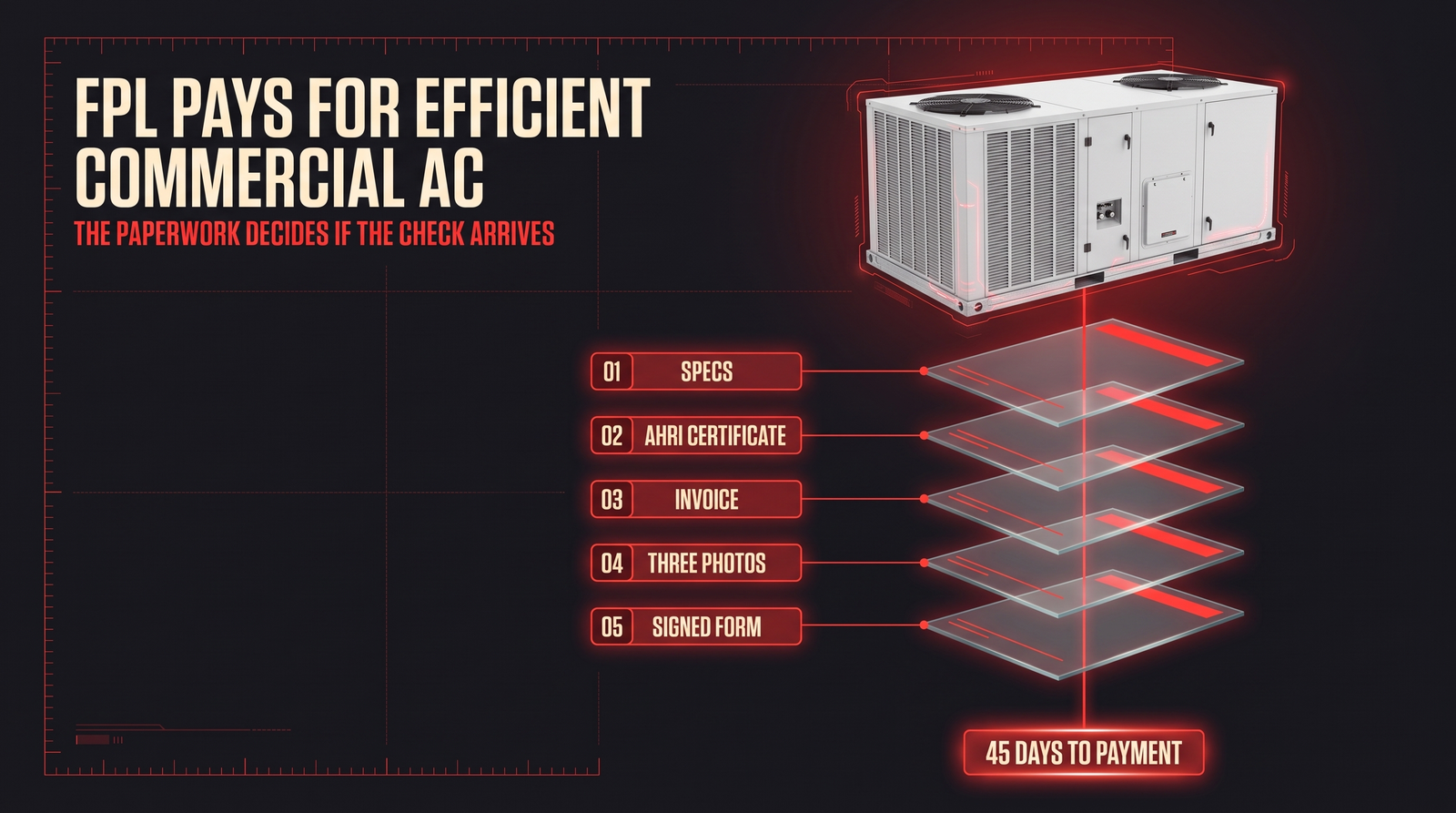
FPL pays the customer, or a designated payee, after 45 days of receiving completed documentation and confirming eligibility. The word that matters is completed. This is what FPL's current checklists ask for.
- Specs, one of three: mechanical schedules, manufacturer spec sheets, or a schedule of values. For DX, the specs need the AHRI performance data, model numbers, quantity of each, cooling capacity, and the efficiency type. For chillers, the specs need the AHRI data at the rating conditions above, including IPLV.
- The AHRI certificate for the installed equipment.
- The original invoice or purchase order, showing the model number and the quantity of units. The DX checklist asks you to highlight them.
- Customer and project details: contact name, phone, email, FPL account number, project name and address, installation date, and the tax ID number.
- Photos of each installed unit. The checklist is specific. One overall photo of the unit installed and operating. One close-up where the model or tag number is readable. One that shows location, taken as a screenshot of the photo's details showing the address. FPL also says rooftop photos should only be taken by people qualified for roof access.
- The installing contractor's license, if available.
- A vendor packet if you are a new payee: a W-9 for the company and address where the check goes, and FPL's new vendor questionnaire.
- A letter of authorization if the payment is going to someone other than the customer.
- The completed and signed rebate form.
Read that list again as a property manager and notice who holds each piece. The contractor has the schedule, the AHRI certificate, the invoice, the photos, and the license. The owner or management company has the account number, the tax ID, the W-9, and the signature. Accounting has the vendor questionnaire. When nobody owns the folder, it is easy for one missing item to sit for months. Put one name on it before the job starts.
A note on the federal tax deduction
FPL's page tells businesses they may also qualify for federal tax incentives for efficient HVAC and lighting. Be careful with that line in 2027 budgets. Under the current federal statute, the energy efficient commercial buildings deduction, Section 179D, does not apply to property whose construction begins after June 30, 2026. Whether a project you are planning qualifies is a question for your tax adviser, not for us, and not for a rebate form. Do not book it in the capital sheet until someone qualified signs off.
What to put in the proposal
Ask for five things in writing, from whoever is pricing the job. We would rather you ask us than find out in February.
- Is the building on an active FPL business account, and is that the account the rebate will go against?
- Does each proposed model meet the line in FPL's current standard for its size, and does the proposal show the AHRI certificate number?
- Will the specs go to FPL for a qualification check before the purchase order, and who is sending them?
- Will the equipment run during the summer weekday afternoon window FPL requires, including any space with a summer shutdown?
- Who owns the closeout folder: specs, certificate, highlighted invoice, the three photos per unit, license, W-9, vendor questionnaire, letter of authorization if needed, and the signed form?
If the honest answer to item 2 is “the unit we want misses the line by a little,” do not swap to a different unit just to hit it. Ask whether the better-fitting unit is the right purchase without the rebate. Our repair, upgrade, or replace guide is the place to start that conversation.
What we would tell a board in one paragraph
FPL's Business HVAC Program pays rebates on qualifying new chillers, DX air conditioners, and pump drives for active FPL business accounts. Under the current standard, smaller DX units are paid per unit, from $200 to $800, and larger units, chillers, and drives are paid on the summer demand FPL calculates the equipment saves. The equipment has to be new, primary, AHRI certified, more efficient than code, and running on summer weekday afternoons. FPL pays after it has complete paperwork, so the specs should go to FPL before the purchase order and one person should own the closeout folder. The federal 179D deduction should not be in the 2027 number until a tax adviser confirms the project qualifies.
Sources
Current as of October 7, 2026. Program details change. Read FPL's current documents before you budget. Nothing here is tax or legal advice.
- “Business Heating Ventilation and Air Conditioning (HVAC) Program Standards, effective September 1, 2025.” Florida Power & Light. Eligibility, equipment requirements, rating conditions, the summer on-peak operation window, rebate amounts, documentation list, 45-day payment timing, and FPL's disclaimers.
- “Business HVAC program page.” Florida Power & Light. Equipment types, eligible organizations, the pre-approval form and two business day response, calculators, and the federal tax incentive note.
- “DX Rebate Checklist.” Florida Power & Light. Spec, invoice, customer detail, photo, license, vendor packet, letter of authorization, and rebate form requirements.
- “Chiller Rebate Checklist.” Florida Power & Light. Chiller spec requirements, including AHRI data at the rating conditions and IPLV.
- “VFD Rebate Checklist.” Florida Power & Light. Pump drive documentation.
- “26 U.S.C. 179D(i), Termination.” U.S. Code, Office of the Law Revision Counsel. “This section shall not apply with respect to property the construction of which begins after June 30, 2026.”