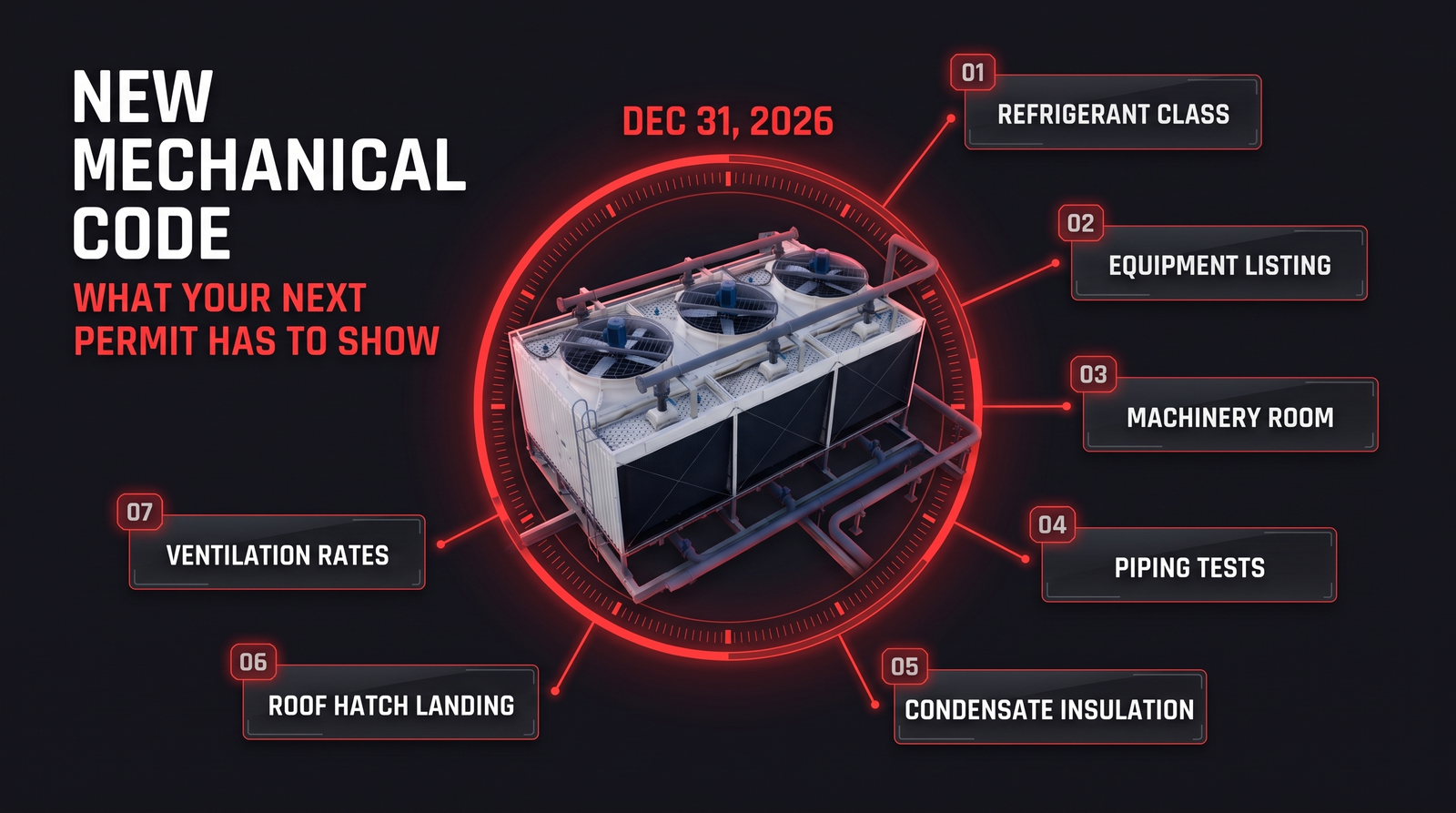
Florida's 9th Edition Building Code, Mechanical is scheduled to take effect December 31, 2026, and Miami-Dade is already enforcing that date on permit applications. Your existing equipment does not have to be replaced because the calendar flips. The next mechanical permit you file is judged against the edition in effect on the day you apply, and that edition changes the refrigerant listing, the machinery room, the piping test, condensate insulation, the roof hatch landing and, for many condominium, school and office projects, the ventilation math. This article covers the two clocks that matter, what does not happen on January 1, the seven changes worth knowing, and five questions to put in writing before the 2027 budget is adopted.
The equipment on your roof does not become illegal on New Year's Day. The permit you file after December 31 is a different story.
Florida is moving from the 8th Edition of the Florida Building Code to the 9th Edition. The Commission's published schedule puts that switch on December 31, 2026. Miami-Dade's permitting office has already told applicants what it will do with that date. If you manage a building, a campus, or a board agenda in South Florida, the useful question this month is not “do we have to replace everything.” It is “which edition will the set in front of the reviewer actually be judged against.”
We should say the obvious thing. We are a mechanical contractor, and we permit this work. An article about a code change is not a neutral document. Here is the part that does not help us sell a replacement: a machine that is legally in place, and that you are not replacing, does not get rebuilt because the calendar flipped. The code edition attaches to the permit application, not to every piece of equipment you already own.
Two clocks, and they are not the same decision
If you read our piece on the hottest summer on record, you already have one deadline in your notes. For buildings that use VRF, variable refrigerant flow, a federal installation deadline of January 1, 2027 is still on the books. That article covers what EPA did and did not change in May. We are not going to walk it again.
The Florida code edition is a second clock. It does not ask whether a particular refrigerant can still be installed under federal rules. It asks which book the plans examiner uses when the application hits the counter. You can be fine on one clock and late on the other. A VRF job that still has a legal refrigerant path can still be drawn to the wrong edition. A straightforward rooftop change-out that nobody thinks of as a “refrigerant project” can still land in the new mechanical chapter if the application date does.
Treat them as two lines on the same schedule, not as one rumor.
What December 31 actually means
The Florida Building Commission updates the code on a three-year cycle, by rule, off the international model codes. The statute that governs the timing says a rule updating the code takes effect no sooner than 6 months after the updated code is published. The Commission's own workplan, approved August 11, 2026, puts the 9th Edition effective date on December 31, 2026, and it labels that date as 6 months after publication.
The same statute answers the question boards actually ask, which is what happens to a permit that straddles the date. The edition in effect on the date of the application governs the permitted work for the life of that permit and any extension granted to it. That is the rule, and it is not a loophole. It is also a rule with conditions. The permit has to stay alive: the work has to start and keep moving, and an application that is abandoned or a permit that lapses is treated as a new one, drawn to whatever edition is in effect when it is refiled. Filing an incomplete set just to grab a number, and then having it bounce or expire, is how a project ends up redrawn to the 9th Edition anyway.
Four limits belong in the same paragraph, because all of them are true.
First, on that workplan, the final rule hearing, the posting of the final PDF, and the printed code were still marked to be determined. The effective-date line was not. It already said December 31, 2026. We are not going to tell you the book is frozen when the Commission's own schedule had steps left open, and its October 13 meeting agenda includes an updated workplan and a rule workshop. Some Chapter 11 text has also been through a correction process, so it may still move at the edges. Check floridabuilding.org before you lock a drawing set, and ask the building official who will review your job which edition that desk is enforcing.
Second, Miami-Dade has not waited on that conversation. The county's Permitting and Inspection Center has issued a notice that the 9th Edition becomes effective December 31, 2026, and that permit applications and plans submitted on or after that date have to comply with it. The detail people will remember is the portal cutoff: an application submitted online after 4 p.m. on December 30, 2026 has to comply with the 2026 edition. That notice is Miami-Dade's. It does not set the clock in Fort Lauderdale, Hollywood, or a city that runs its own counter. If your building is not in Miami-Dade's permitting jurisdiction, ask that office the same question in October. Do not assume the 4 p.m. rule traveled with you.
Third, counties and cities may adopt local technical amendments to the code, and Miami-Dade and Broward do not always match the statewide book. The fire code that governs refrigerant machinery-room safety is also adopted separately from the Building Code. Ask your building department what applies locally on top of what we describe here.
Fourth, the International Code Council's page for the Florida Building Code, Mechanical, 9th Edition (2026) states the same effective date, December 31, 2026. That volume is the 8th Edition mechanical code updated with the 2024 International Mechanical Code and Florida's amendments. Not every change in the 2024 model code was adopted here. If someone hands you a national summary and calls it “the Florida code,” make them show you the Florida section.
What does not happen on January 1
An agency or local government may not require existing mechanical equipment on a roof to be brought up to the Florida Building Code, except during reroofing when that equipment is being replaced or moved and it is not in compliance with the code provisions on roof-mounted mechanical units. That is current Florida statute. It is the sentence to read out loud if a meeting starts to treat December 31 like a replacement order.
A change-out you choose to do, or a reroof that moves the units, is permitted work. Permitted work follows the edition in effect on the application date. Those are different facts, and boards get them tangled.
Nothing in this article is a legal opinion. How a section lands on your building depends on the scope, the occupancy, and the official reviewing it. That is a question for your engineer and, when the building is a condominium, for association counsel.
Seven changes that shape a mechanical project
The Commission posted an Analysis of Changes that compares the 8th Edition (2023) mechanical code to the 9th Edition (2026). The analysis says, in its own introduction, that it is not a substitute for either code book and that it does not interpret them. Use it as a map. Have the engineer read the section, not the summary.
These are the highlights that change the conversation for a commercial or multifamily mechanical project. They are the Commission's descriptions, not ours, and the list is not complete.
-
The refrigerant in a new comfort-cooling system
High-probability direct systems for human comfort have to use either Group A1 or Group A2L refrigerants. That is the code catching up to the lower-global-warming-potential refrigerants manufacturers already moved to. It is not a suggestion to pour a new refrigerant into an old machine. The section on changing refrigerant type was also revised so a change from one safety class to another tracks ASHRAE 15. If a proposal on the table is “keep the piping, change the gas,” that is the section your engineer should be in before anyone prices it. We wrote separately about why the new refrigerant equipment costs more. This piece is about whether the installation is allowed to be designed the way the last one was.
Section 1104.3.1 and 1101.8 -
The listing on the equipment
High-probability equipment that uses Group A2L, A2, A3 or B1 refrigerant has to comply with UL 484, UL/CSA 60335-2-40, or UL/CSA 60335-2-89. On a submittal, that is a line you can check. If the cut sheet does not show the listing, do not discover that in review.
Section 1101.2.1 -
The machinery room, if you have one
Rooms larger than 1,000 square feet need at least two exits or exit access doorways, with requirements on the doors, the travel distance, and panic hardware. For rooms serving Group A2L or B2L refrigerants, the analysis describes a new block of rules: no permanently installed open-flame devices, and no continuously operating hot surfaces over 1,290 degrees F; refrigerant detectors that alarm and start ventilation within a set response time; and mechanical ventilation that complies with ASHRAE 15. A chiller plant that was legal to build ten years ago is not automatically illegal. A chiller plant you are modifying under a 2027 permit has to be drawn against these sections, not against memory.
Section 1105.10 and 1106.5 through 1106.5.3 -
The piping test
The analysis says two tests are now required, a pressure test and a vacuum test, and the allowed field test gases are updated. Oxygen-free nitrogen, helium, argon, or a premixed nonflammable oxygen-free nitrogen with a hydrogen or helium tracer are in the description. Carbon dioxide is allowed as the test medium on R-744 systems, and water on R-718. We are not going to invent a test pressure the analysis does not state. The point for a facility director is simpler. Ask, in the proposal, whether the price includes both tests and a record of them. A startup sheet that only says “pressurized and held” is not the same document.
Section 1110 -
Condensate drain insulation
Condensate drain piping from cooling coils and evaporators, when it runs inside unconditioned space, has to be insulated to at least R-3. That is not a machinery-room issue. It is a closet, a garage, a crawl, a shaft. It is the kind of thing that fails a final inspection on an otherwise finished job.
Section 307.2.2 -
The roof hatch landing
Permanent ladder dimensions are updated to OSHA, and a top landing is required at the roof hatch: clear, at least 30 inches deep, and as wide as the hatch. If the only way to the units is a hatch that opens into nothing, a replacement that includes that access can pick up this item. It is also the item most likely to surprise a project that was scoped as “swap the unit” and drawn as nothing else. The requirement does not apply to Group R-3 occupancies, and it is not a reason to reopen a roof that nobody is permitting.
Section 306.5 -
Ventilation rates, for the buildings that teach and the buildings people live in
The minimum-ventilation table adds occupancy rows, including, for schools, education break rooms, coffee stations and corridors; for offices, break rooms and occupiable storage rooms for dry materials; and for hotels, motels, resorts and dorms, laundry rooms, both central and inside the dwelling unit. The analysis does not print the cubic-feet-per-minute numbers in the narrative, so we will not guess them. If you are about to renovate a school wing or an office floor, the design outside-air number has to come from the new table, not from the set you used in 2023.
Section Table 403.3.1.1
For condominiums and other Group R-2 buildings, the dwelling-unit outdoor air section is revised so it applies to all R-2, R-3 and R-4 occupancies, not only buildings of three stories or less. In the outdoor-air equation for dwelling units, the factor on floor area changes from 0.01 to 0.03, and the floor area in that equation is conditioned floor area. The factor triples. What that does to the total outside air for a given unit depends on the unit, and it is not a number we are going to run for a fictional tower. Have the engineer of record run it on your building before the capital line gets locked. Our explainer on how a commercial cooling load is calculated is the companion piece: outside air is one of the inputs, and in this climate it is often the one that decides whether the building feels dry.
If you run a school and you already use our indoor-air-quality piece as the operating guide, keep using it for filtration and humidity. Use this article for the moment a renovation has to be permitted. Those are different jobs. (Section 403.3.2.1 and Equation 4-9.)
What to do before the budget meeting
Most of the buildings we work in are pricing 2027 work right now. The code question belongs in that packet, next to the equipment price, not in a footnote after the vote.
Ask for five things in writing. None of them require a guess about what a reviewer might feel like doing in January.
Which office reviews this building
Which jurisdiction reviews it, and has that office said which edition it will enforce on applications filed in December versus January? If the answer is “we think Miami-Dade's notice applies,” and the building is not in Miami-Dade's permitting jurisdiction, the answer is not done.
The real application date
What is the date of a complete submittal that office will accept, not a placeholder? Work backward from December 30 only if the drawings, product data, and product approvals are actually ready. A rushed file that bounces does not lock the 8th Edition.
What the scope pulls in
Does the scope include a refrigerant-class change, a machinery room, a roof hatch, or a ventilation redesign? If yes, the 9th Edition sections above are in the set even when the rest of the building is untouched.
What the price includes
Are the submittals listed to the standard the new equipment section names, and does the price include the pressure test and the vacuum test with a record?
Who owns the equipment
If this is a condominium, does counsel agree the work is an association project and not a unit-owner system? The code edition does not answer that. The declaration does. We have written about that distinction in the reserve-study piece. It still decides who is allowed to approve the number.
If the honest answer to the second question is “the set will not be ready until 2027,” stop trying to beat the date. Draw it to the 9th Edition now. Redrawing a rejected 8th Edition set in February is the expensive version of the same engineering.
What we would tell a board in one paragraph
December 31, 2026 is the date on the Commission's schedule and the date Miami-Dade is already enforcing in its notice. Your existing equipment does not have to be replaced because that date arrives. The next mechanical permit does have to be drawn to the edition in effect when you apply, and that edition changes the refrigerant listing, the machinery room, the piping test, the condensate insulation, the roof-hatch landing, and, for many residential and school projects, the ventilation math. Get the edition confirmed by the official who will review your job, and get the engineer to price that edition, before the 2027 number is adopted. If the work is not ready to file, design it to the new book instead of hoping the old one stays available.
Sources
Current as of September 30, 2026. The Commission's schedule and text can still change before the code is final, so confirm both with floridabuilding.org and with the building official who will review your job. Read the section, not just this article: the Analysis of Changes says it is not the code. Statutory citations are to the 2026 Florida Statutes and are not legal advice, and how any provision applies to your building depends on your scope, occupancy and declaration, which are questions for your engineer and association counsel.
- “553.73 Florida Building Code.” The 2026 Florida Statutes. The three-year update cycle at (7)(a); the 6-month floor after publication at (7)(e); the edition in effect on the application date governing the permitted work for the life of the permit and any extension at (7)(d) and (6); local technical amendments at (4); and the limit on forcing existing roof-mounted equipment into compliance, except during reroofing, at (15)
- “2026 FBC Workplan, August 2026.” Florida Building Commission. The 9th Edition effective date of December 31, 2026, labeled as 6 months after publication, on the workplan the Commission approved August 11, 2026; final rule hearing, final PDF and printed code still marked to be determined on that workplan
- “Florida Building Code 9th Edition Code Change.” Miami-Dade County Permitting and Inspection Center. Effective December 31, 2026; applications and plans on or after that date must comply; online applications after 4 p.m. on December 30, 2026 must comply with the 2026 edition; expired applications that do not meet the county's extension rules must be resubmitted to the 2026 edition
- “Florida Building Code, Mechanical, Ninth Edition (2026).” International Code Council. States an effective date of December 31, 2026, and describes the book as the 8th Edition updated from the 2024 International Mechanical Code with Florida amendments
- “Analysis of Changes for the 9th Edition (2026) Florida Building Code, Mechanical.” Florida Building Commission. Source for every section summary in this article: 1104.3.1, 1101.8, 1101.2.1, 1105.10, 1106.5 through 1106.5.3, 1110, 307.2.2, 306.5, Table 403.3.1.1, 403.3.2.1 and Equation 4-9. The analysis states that not every 2024 IMC change was adopted, and that it does not replace or interpret the code
- Final rule, 91 Fed. Reg. 31284 (May 26, 2026), Document 2026-10387. Federal Register, U.S. EPA. The final rule, effective July 27, 2026, removing the installation deadline for legacy residential and light commercial equipment made or imported before January 1, 2025, and leaving the VRF installation deadline at January 1, 2027
- “South Florida's Hottest Summer on Record Just Ended. Here Is What to Check.” ABC Mechanical Insights, September 19, 2026. Used only as the pointer to the separate federal VRF installation deadline